
Key Insight #2
Whether via a traditional print newspaper, a familiar face on your favorite news channel, a brief podcast episode on the way to work, or a credible source’s post on social media, it is common for Americans to consume news in one form or another. So, journalists and news outlets must determine what should be deemed “newsworthy.” In other words, “what should be deemed relevant and worthy of their viewer’s attention?” To do this, journalists have relied on the concept of the “Five Key Elements of Newsworthiness.” Professionals across the field of communications also take these elements into consideration. This concept is particularly important to public relations specialists, whose job is to encourage the news media to cover stories involving the organizations they represent and shape that coverage to meet the organization’s needs. So, while the media can not necessarily tell its audience how to think, it can tell the public what to think and discuss. This theory, which is that the media determines the issues we need to think about and talk about, is called the “Agenda-Setting Theory.”
The Black Honors Caucus Executive Board Fall 2024 photo shoot
During an election year, the media frequently discusses specific issues such as abortion, ongoing wars, immigration, or the economy. In doing so, the Agenda-Setting Theory claims that the public also begins to think about those same issues and hence use the candidates’ stances on the issues to determine whom they support. However, if the media decides to stop covering these critical issues, the public will also slowly stop thinking about them and, thereby, stop discussing them. A candidate can use this fact to their advantage by establishing their stance on issues that have the attention of the public rather than obscure issues that would not necessarily matter to the general public because they are not discussed in the media. By taking SCHC 384: Research Like a Pro: Exploring Quantitative Social Science Methodologies in Spring 2024, I was able to conduct research as “a campaign strategist” would for a presidential candidate to develop a campaign strategy with the Agenda-Setting Theory in mind. When I worked on this project, there were three Republican candidates—Donald Trump, Nikki Haley, and Ron Desantis. Also, during this time, the presumed Democratic nominee was the incumbent Joe Biden.
I decided to analyze a candidate who I believed to be in quite a unique and interesting position due to a combination of her background, experience in politics, and party affiliation. So, in the spring of 2024, my goal was to determine which campaign issues and Nikki Haley’s character attributes could be considered her significant strengths and which could be considered major weaknesses during her 2024 presidential campaign.
SCHC 384 Presentation
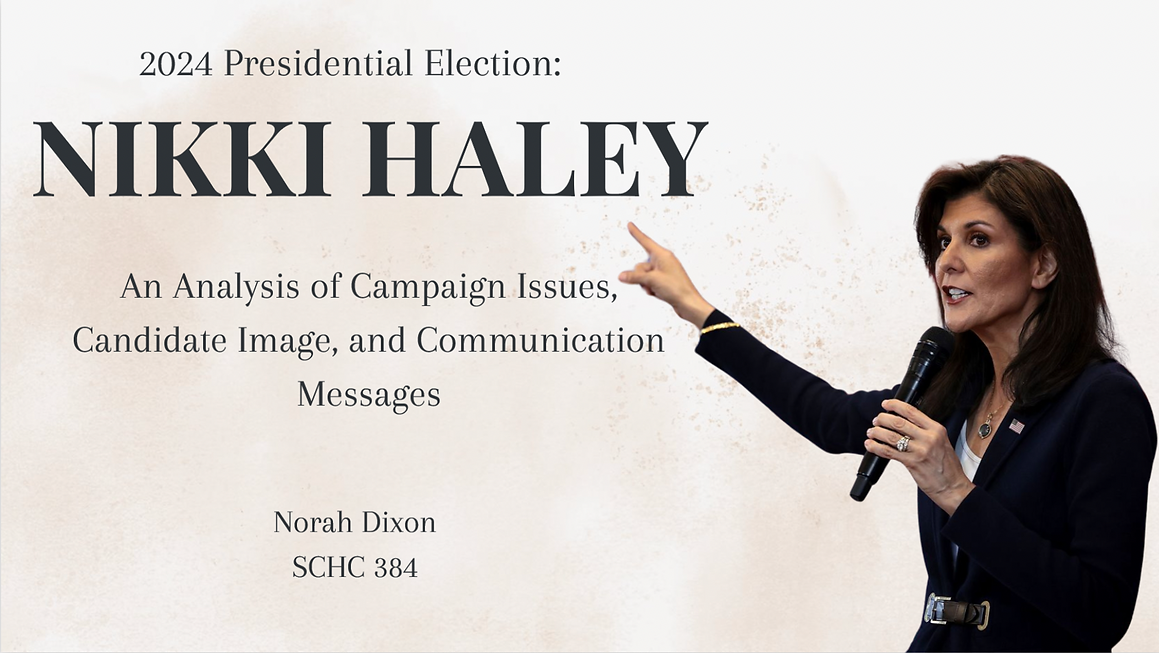
In Stage 1, I conducted a literature review to determine which campaign issues and candidate attributes have typically impacted a voter’s evaluation of a candidate. I also traced the fluctuations of public support for Nikki Haley using the results of opinion polls. In Stage 2, I used several news articles published by diverse sources over six months to conduct a SWOT analysis of Nikki Haley’s campaign. Then, I identified eight campaign issues and eight personal attributes that I believed could potentially be most beneficial for Haley’s campaign to focus on. Next, I created a survey using the Qualtrics survey platform to evaluate how a voter’s view of Nikki Haley is shaped by her stance on the key issues and the eight personality attributes I identified. Then, I used QUID, an AI-powered consumer and market intelligence system, to evaluate how voters perceive Haley on Twitter. In Stage 5, I used SPSS, a statistical analysis computer program, to evaluate the data from the survey I conducted in Stage 3 to determine which campaign issues and personal attributes are most closely associated with a voter’s perception of Haley. Finally, I wrote a report on my work and presented my findings to my classmates. Please see my presentation above.
I immediately saw how the Agenda Setting Theory applied to my work analyzing Nikki Haley’s campaign for the 2024 Presidential Election. However, I began to realize that I practice this theory in my everyday life. While this theory is most often applied to the news, I have been able to also apply it in my role as the Publicity Chair for the Black Honors Caucus (Fall 2022-Present), and I previously applied it in my job as a Marketing Intern for the Student Success Center (Jan. 2021-Dec. 2023). In both roles, my goal was to create digital content promoting the entity it represents.


BHC Instagram Feed
The Black Honors Caucus Instagram feed which demonstrates the graphics and posts I created as the Publicity Chair
As a Marketing Intern for the SSC, I created content to promote the resources the SSC provided and UofSC as a whole. For example, I created videos highlighting the student experience at UofSC, such as spotlighting the top dining halls or study spots on campus, filming a student’s perspective at sporting events, and creating “Day in the Life of a UofSC Student” short videos. I also represented the SSC at university events, telling prospective and admitted students about the SSC’s resources. In my role as the Publicity Chair for the BHC, I create digital, promotional, and marketing content for the organization and represent the BHC at university and South Carolina Honors College outreach events.
It was second nature for me to focus on the many amazing aspects of the BHC, the SSC, and UofSC because I have had great experiences with each of these entities. However, in focusing only on specific aspects of the SSC or the BHC, I, even if inadvertently, shaped the public’s opinion of what they should think about when they evaluate or discuss USC, the BHC, or the SSC. I frequently create content that solely highlights both the organization and the office, so when people think of the BHC or the SSC, they have a positive perception.
That semester, I realized that the Agenda-Setting Theory is not solely used by large agencies or news stations; it can be applied to something as trivial as the way a student organization or an office uses the media to promote itself. In being able to make this connection, I now see the Agenda Setting Theory in a new light. I previously believed that this theory over-emphasized the “dark side” of the media and mass communications. Now, I see that everyday organizations that work for the good of their audience, such as the Black Honors Caucus and the Student Success Center, can use this theory to raise awareness of the opportunities they provide and highlight the work of their members.
As someone pursuing law school and particularly interested in First Amendment law, this paradigm shift regarding the Agenda-Setting Theory has provided me with a new outlook on the freedom of the press. The press’ lack of censorship by the government leaves a whole avenue of topics for the press to cover. However, this freedom means that the press cannot cover every single story or, in the case of my SCHC 384 project, policy issues. The media has to use the Five Elements of Newsworthiness to determine what stories or issues should be covered and which would not be appealing to their audiences. As a result, the press will inevitably “set the agenda,” determining what the public thinks about. In any profession, when disseminating information about one’s organization, even if inadvertently, they shape the public’s perception of that entity.