
Key Insight #3
Public history displays can be crucial to ensuring that a community’s history is remembered for decades, maybe even centuries to come. Previously, historical displays were limited to museums, monuments, building preservation, etc. However, today, historians have been able to make public history displays utilizing the unique opportunities the media offers. Now, historians have preserved and disseminated information about various aspects of history through websites, social media pages, digital presentations, and even video games. With this expansion of methodology, more people from across the world and of different backgrounds can appreciate the displays created by historians. As historians develop displays that now reach audiences outside of academia, the need to ensure the information presented is understandable to a vast audience has arisen.
Above is an image of me with my research mentor, Dr. Christian Anderson and his colleague, Dr. Kevin Harrelson
In the fall of 2023, I had the opportunity to work on my first public history display. Only it was not a traditional display. Rather, my classmates and I developed a digital display of the history of the South Carolina Honors College (SCHC) to be displayed in Harper College. This was done as the service proponent of SCHC 328: Legacies of USC, a service-learning course. In SCHC 328, my classmates and I learned how to create a public history display that is relevant and catered to professionals in academia yet easily understandable by the general public.
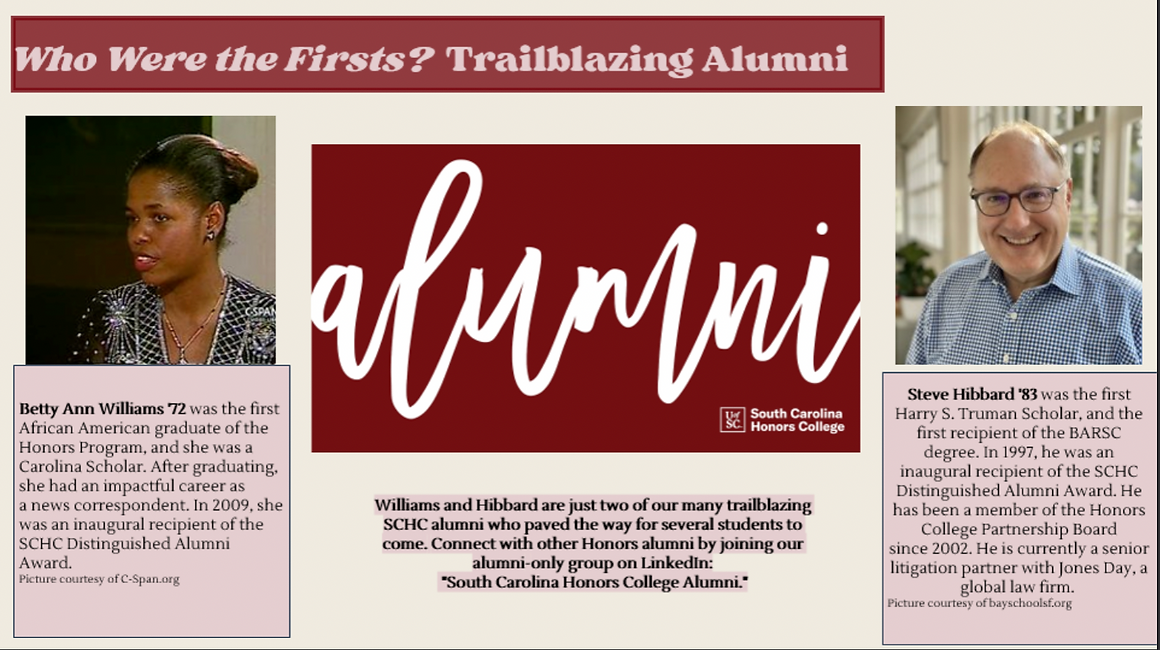
In class, my group dedicated time to researching the history of the Honors College and decided which pieces of information would be most relevant to our audience. Once we decided which information we thought would be relevant to our audience, we worked with the SCHC Communications Team to ensure our presentation was accessible and suitable to our “client,” the SCHC. Not only did we learn from the SCHC Communications team who specializes in digital content, but our professor, Dr. Anderson, also has much experience in curating public history displays. So, in this experience, I learned how to ensure the information I presented was factual but presented in a way that was simple for my audience to follow. As a result, our display needed to have a “balance” between text and other supplementary materials such as images and a “balance” between information geared towards the general public and professionals in the field. As a result, my group decided to create eye-catching infographics and include images emphasizing the text on the slide. Ultimately, our final result catered to the general public and those who are more knowledgeable about the SCHC’s history. Below is the slide I created in our presentation. At the midway point and end of the semester, my group and I had the opportunity to display our presentation to the Honors College faculty and staff who provided us with feedback. In the end, we were able to see that the methods we used to curate our display were effective. In the feedback we received, our audience praised the combination of text and images, as well as the information we included being both relevant and engaging as seen in the presentation below.
In SCHC 328, Dr. Anderson also taught the class about the many obscure aspects of USC’s history, such as slavery on campus, campus during the World Wars, and the Months of May protests. Therefore, in addition to creating a public history display for the Honors College, my classmates and I each researched, presented, and led discussions on an aspect of USC’s history of our choosing. I decided to focus my research on Richard T. Greener, USC’s first African American professor, and USC’s period of Reconstruction. Through the research I conducted leading up to my presentation and research paper, I discovered I had an interest in Richard T. Greener’s story and the Reconstruction-era South.
SCHC 328 Presentation Excerpt
During a lecture, Dr. Anderson mentioned to the class a project he was starting on the works of Richard T. Greener. After class, I immediately asked him if he needed an undergraduate research assistant, and within a few days, Dr. Anderson brought me samples of Greener’s handwritten essays. The first essay I began transcribing was Greener’s essay entitled “The Academic Life.” SCHC 328 opened the door to my first undergraduate research experience. More importantly, this course taught me the frameworks I need to successfully present my findings on Richard T. Greener’s essay, “The Academic Life,” at my first research conference—the Southern History of Education Society Conference (SHOES).
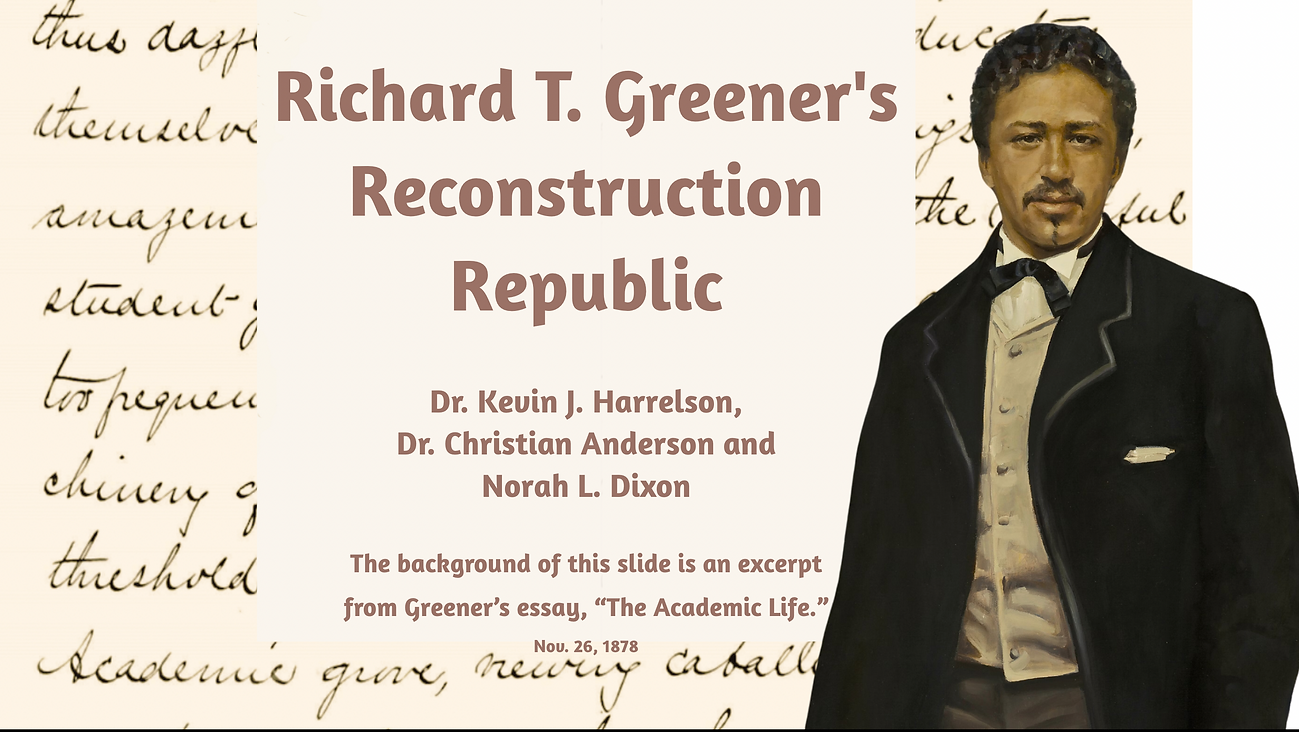
Similar to the audience of the display I created in SCHC 328, the SHOES conference consisted of people who were already experts on the topic–historians who focused on Southern history. However, I knew that, like the display I created in SCHC 328, I also wanted to ensure my presentation and speech would be accessible to people who did not have a background in USC’s history. As I did in class, my preparation for the SHOES Conference began with research. First, I read and transcribed Greener’s essay and did additional research to contextualize his writings and determine which aspects of his essay my audience might find most relevant. Keeping the idea of “balance,” which I learned in SCHC 328, in mind, the presentation I created for the SHOES Conference had a balance of photos, excerpts from Greener’s text, and commentary. However, there was one major difference between my presentation at the SHOES Conference and my project in class–this presentation was not a display. As a result, I presented my information verbally rather than allowing the display to speak for itself. In learning how to conduct historical research and prepare a display that had a balance between text and visuals and catered to various audiences, I was prepared to successfully present my research findings on Greener at my first research conference. Below is our presentation from the SHOES Conference.
SHOES Conference Presentation

I am grateful that I decided to pursue a GLD in Professional & Civic Engagement because it has helped me to connect leadership theories and skills I learned in class with ways to positively impact my community or profession. In SCHC 328, I created a public history display that told the story of the Honors College to my community. In particular, I ensured that information about marginalized communities who impacted the SCHC was also highlighted. The frameworks I learned in this course prepared me to present at my first professional conference. Most importantly, I gained a newfound appreciation for public history displays and now see their value in a new light. Not only do they have the ability to share untold stories, such as the experience of the first black student in the SCHC or Richard T. Greener’s story, but the skills one learns in curating a public history display are applicable in different fields. As someone who aspires to become an attorney, I know how important it is to be able to gather information, analyze it to determine which pieces are relevant, and then determine how to present it in a manner that caters to your audience. While I will not always be creating public history displays or presenting at a research conference, I believe that knowing how to research, analyze, and properly disseminate that information is a valuable trait to have in any profession, especially the legal field.
Above is an image of be presenting my portion of the presentation